

Data quality management (DQM) is the ongoing discipline of keeping data accurate, complete, and trustworthy.
It used to be enough to run DQM as a periodic cleanup: profile the data, cleanse it, move on. AI agents have changed that math. An agent doesn't pause to question a stale table or a mislabeled column. Instead, it acts on whatever it's given and produces a confident answer regardless of whether the underlying data actually holds up.
For Chief Data Officers (CDOs), Chief Data and Analytics Officers (CDAOs), and the data governance and quality leads accountable for what feeds production AI, the stakes are the same: nothing downstream works if the data underneath it can't be trusted.
This guide breaks down what data quality actually means and why data quality management has become a board-level priority as AI adoption accelerates. It offers how to evaluate data quality solutions (from point tools to data quality management software) that fit how your organization works.
What is data quality?
Data quality is the degree to which information meets an organization’s standards for accuracy, validity, completeness, consistency, uniqueness, and timeliness.
High-quality data enables confident, informed choices. When data quality fails, it undermines customer service, productivity, governance, and strategy.
Even a single error can ripple across systems, disrupting reports, analytics, and planning. Poor data quality also erodes credibility, damages stakeholder trust, and can create regulatory, reputational, or financial risks.
By continuously monitoring and addressing issues via data management, organizations can ensure that data remains fit for its intended purpose and delivers value across the business.
What is data quality management?
Data quality describes a state: is this dataset good or bad right now? Data quality management, meanwhile, is the continued practice of enhancing and maintaining quality. It’s the practice, not the outcome.
Data quality management often includes:
Profiling data to find issues
Cleansing what's broken
Validating new data against rules
Monitoring for drift
Managing the metadata that gives every value context
Data degrades the moment context goes stale, and static fixes don't hold. That's why Alation treats data quality as a gate, not a dashboard, flagging degraded data before an agent ever consumes it.
Why is data quality important?
Data quality is important because it directly impacts the accuracy and reliability of information used for decision-making. Quality data is key to making accurate, informed decisions. While all data has some level of “quality,” a variety of characteristics and factors determine its exact degree (high-quality versus low-quality).

That principle now extends beyond human decision-making to AI. As organizations deploy AI agents to automate analysis, generate reports, answer business questions, and trigger workflows, data quality management has taken on a new dimension of urgency.
It is no longer just the foundation for good human decisions, but also the prerequisite for AI that works. An agent querying stale or inaccurate data does not produce a worse answer; it produces a confidently wrong one.
And unlike a human analyst who might notice something feels off, an agent will act on what it is given. The quality of the data your agents consume determines the trustworthiness of every output they produce.
What is good data quality?
A single inaccurate data point can cascade across every downstream system that touches it. That includes reports, models, and agent outputs alike.
Without accuracy and reliability in data quality, executives cannot trust the data or make informed decisions. This increases operational costs and wreaks havoc for downstream users.
Analysts wind up relying on imperfect reports and making misguided conclusions based on those findings. And the productivity of end-users will diminish due to flawed guidelines and practices being in place.
Poor data quality management creates other problems, too. For example, out-of-date customer information can result in missed opportunities for up- or cross-selling products and services.
Low-quality data can cause companies to ship their products to the wrong addresses. This can result in lowered customer satisfaction ratings, decreases in repeat sales, and higher costs due to reshipments.
And in more highly regulated industries, bad data can result in the company receiving fines for improper financial or regulatory compliance reporting. These are the stakes for human decision-making, and they compound sharply once AI agents start acting on the same flawed data unsupervised.
Data quality management practices
Effective data quality management runs on five core practices, each targeting a different failure point in the data lifecycle.
Most teams treat these as a sequence: profile once, cleanse, validate, then move on. But data doesn't stay fixed.
The practices below work best running continuously and in parallel, not as a one-time checklist you complete and file away:
Data profiling: Examining datasets to understand their structure, patterns, and anomalies before defining rules.
Data cleansing: Correcting or removing inaccurate, duplicate, or malformed records.
Data validation: Checking new data against defined rules at the point of entry, before it spreads downstream.
Data quality monitoring: Continuously tracking data health over time to catch degradation before it reaches a report or an AI agent.
Metadata management: Maintaining the business context and definitions that make data usable and trustworthy in the first place. Without it, even accurate data is hard to interpret correctly.
If you're standing up client data infrastructure, ask yourself:
Can you name your three most business-critical datasets, and who owns their quality?
Do quality issues get caught before or after they reach a report or an AI agent?
Is your metadata maintained continuously, or refreshed only when something breaks?
If any answer is "not sure," that's the gap to close first before it evolves into the challenges below.
Want a head start? Alation's Data Quality datasheet breaks down how AI-recommended rules and continuous monitoring cover exactly these five practices at scale.
Top 3 data quality challenges
Data volume presents unique challenges to data quality management.
Whenever large amounts of data are at play, the sheer volume of new information often becomes an essential consideration in determining whether the data is trustworthy. For this reason, forward-thinking companies have robust processes in place for the collection, storage, and processing of data.
As the technological revolution advances at a rapid pace, the top three data quality challenges include:
1. Privacy and protection laws
The General Data Protection Regulation (GDPR) and the California Consumer Privacy Act (CCPA), which gives people the right to access their personal data, are substantially increasing public demand for accurate customer records. Organizations must be able to locate the totality of an individual’s information almost instantly and without missing even a fraction of the collected data because of inaccurate or inconsistent data.
2. Artificial Intelligence (AI) and the accuracy problem
AI and machine learning create a data quality challenge that is fundamentally different from the volume challenge organizations faced in earlier generations. Agents need data that's accurate, current, and well-described enough to reason over.
When an AI agent runs a query or generates an answer, it relies on the quality of the underlying data and the richness of the metadata describing it.
A column with a misleading description will cause an agent to misinterpret the data it contains. A table with stale values will produce answers that were accurate last quarter but are wrong today.
And unlike a human analyst who might cross-check an unusual result, an agent will accept what it is given and act accordingly.
This creates what practitioners call the context staleness problem. Context that is given to an agent starts decaying the moment it is deployed.
It’s also why data quality is showing up inside AI compliance frameworks directly. The EU AI Act's data governance requirements, NIST's AI Risk Management Framework, and ISO 42001 all treat the accuracy and traceability of training and operational data as a control point and not an afterthought.
Metric definitions get updated. Tables get deprecated. New data sources come online. Without a mechanism to keep data quality signals flowing continuously into the context layer that agents rely on, the gap between what an agent thinks it knows and what is actually true in the data widens over time.
The teams making real progress with enterprise AI are treating data quality not as a reporting hygiene issue but as the upstream gate that determines whether agents are trustworthy. Poor data quality no longer just hurts dashboards. Now, it also directly undermines the AI agent evaluations that measure whether agents are producing outputs worth acting on.
The scale of the problem is stark. Gartner has found that organizations in complex industries can spend up to 94% of their time preparing data for analytics and AI, leaving little room for the analysis itself. 1
3. Data governance practices
Data governance is a data management system that adheres to an internal set of standards and policies for the collection, storage, and sharing of information.
Without the right data governance approach, the company might never resolve inconsistencies within different systems across the organization.
For example, customer names can be listed differently depending on the department. Sales might say “Sally.” Logistics uses “Sallie.” And customer service lists the name as “Susan.”
This poor-quality data governance can result in confusion for customers that have multiple interactions with each department over time. Additionally, it can result in non-compliance with important regulations and carry the risk of the business being fined.
Fixing inconsistencies like this is what governance is for, but it only handles the problems you already know about. The challenges below are the ones sneaking in from somewhere new.
Emerging data quality challenges
As data changes, organizations face new issues that demand data quality solutions. Consider these additional challenges:
Data quality in data lakes
When data lakes store a variety of data types, data quality management is doubly challenging. Organizations need effective strategies to ensure data in data lakes remains accurate, up-to-date, and accessible.
When structured and unstructured data sit in the same lake but get validated on different schedules, a stale record can pass every check and still reach a report unnoticed.
Dark data
Dark data describes data that organizations collect but do not use or analyze. It can present a big problem. Uncovering valuable insights from dark data while maintaining its quality is a growing concern.
Data that's collected but never analyzed can accumulate quality problems for years without anyone knowing. The issues only surface once someone finally tries to use it.
Edge computing
The rise of edge computing, where data is processed closer to its source, introduces challenges in ensuring data quality at the edge. Organizations must address issues related to data consistency, latency, and reliability in edge environments.
When devices process data locally instead of syncing to a central system in real time, something as small as a device's internal clock falling out of sync can throw off the timing of every reading it produces.
Data quality ethics
Ethical considerations in data quality are gaining importance. To safeguard data quality, leaders must address bias, fairness, and transparency questions as they relate to data collection and usage, particularly in AI and ML applications.
For example, State Farm is currently defending a federal lawsuit alleging its claims-fraud algorithm subjected Black homeowners to disproportionate scrutiny and delays. The court let the disparate-impact claim move forward, and the case remains active.2
Data Quality as a Service (DQaaS)
The emergence of DQaaS solutions offers opportunities and challenges. Organizations must evaluate the effectiveness and reliability of third-party data quality management software while integrating it into their data ecosystems.
Outsourcing data cleansing to a third party can quietly introduce new quality problems, like formatting rules built for one region silently corrupting records from another.
Data quality in multi-cloud environments
Managing data quality across multiple cloud platforms and environments requires specialized expertise. Inconsistent data formats, accessibility issues, and integration complexities must be addressed.
Storing related data across separate cloud platforms can lead to mismatched formats. For example, one system logging a cost field in dollars and another in cents produces wrong numbers once combined.
Data quality culture
Building a data quality culture across the organization is an ongoing challenge. Educating employees about the importance of data quality management and encouraging data stewardship is essential for long-term success.
When only one team monitors data quality, errors introduced elsewhere in the organization get fixed downstream instead of at the source. As a result, the training gap that caused these issues in the first place never gets addressed.
Solving these emerging challenges still comes down to keeping data reliable enough to support data-driven decision-making. But AI agents raise the bar on that discipline in a way human decision-makers never did, which is where accuracy becomes the real test.
Data quality and AI agent accuracy: The critical connection
For AI agents to produce trustworthy, actionable outputs, data quality is the ultimate gatekeeper. But “gatekeeper” only matters if something is actually being governed, which is why it matters to distinguish between AI governance and Governed AI.
AI governance is cataloging models, registering agents, and tracking compliance.
Governed AI means the knowledge your agents consume is accurate, improving, and defensible, so agents can operate with enough autonomy to actually move the business forward.
Data quality management is what makes Governed AI possible in the first place. Without clean, monitored data feeding into it, there's no context worth governing.
Institutional wisdom and context are the foundation
Every AI agent relies on institutional wisdom and context. These are the metadata and business definitions that explain what data means and how to use it.
However, this contextual foundation is only as good as the raw data beneath it. To protect your outputs, you must understand the difference between two approaches:
Monitoring dashboards: Tell you something went wrong after the fact.
Governance gates: Flag data degradation (freshness, completeness, and rule violations) before an agent consumes it and ships a flawed answer to stakeholders.
Data quality drives evaluation scores
In AI development, evaluation runs measure accuracy against a defined gold standard. An agent's performance is driven less by model sophistication and more by data and metadata enrichment.
Case in point: In benchmark testing, a SQL agent utilizing raw, unenriched tables achieved only 60% accuracy on business questions. By simply improving the underlying metadata and data descriptions (without changing the AI model itself) accuracy reached 100%.
Accuracy is not a feature you configure once. Rather, it is a property you improve continuously by refining the data the agent consumes.
Avoiding the "headcount trap"
Data is dynamic. When a table goes stale or a metric definition changes, an agent will continue reasoning using outdated context, producing confidently incorrect outputs.
Without continuous quality signals flowing into the AI's context layer, organizations fall into the headcount trap. This occurs when every deployed AI use case requires a human team to manually monitor data drift. At scale, this maintenance burden consumes the capacity needed to build new use cases.
To scale AI successfully, treat data quality monitoring as foundational, automated infrastructure rather than a periodic audit.
Benefits of good data quality
High data quality has multiple advantages.
It saves money by reducing the expenses of fixing bad data and prevents costly errors and disruptions. It also improves the accuracy of analytics, leading to better business decisions that boost sales, simplify operations, and deliver a competitive edge.
High data quality builds trust in analytics tools and BI dashboards. Reliable data encourages business users to use these tools for decision-making instead of relying on gut feelings or makeshift spreadsheets.
Efficient data quality management also allows data teams to focus on more valuable tasks, like helping users and analysts use data for strategic insights and promoting data quality best practices to reduce errors in daily operations.
And increasingly, the most important benefit of data quality solutions is AI agent performance. Organizations with well-governed, continuously monitored data find that their AI initiatives move from pilot to production faster, achieve higher eval scores sooner, and require significantly less manual intervention to stay accurate as data changes.
The investment in data quality doesn’t just pay dividends in reports and dashboards. It also compounds across every AI use case built on the same data foundation.
How to measure data quality: 6 standards & dimensions
The Data Quality Assessment Framework (DQAF) is a set of data quality dimensions, organized into six major categories: completeness, timeliness, validity, integrity, uniqueness, and consistency.
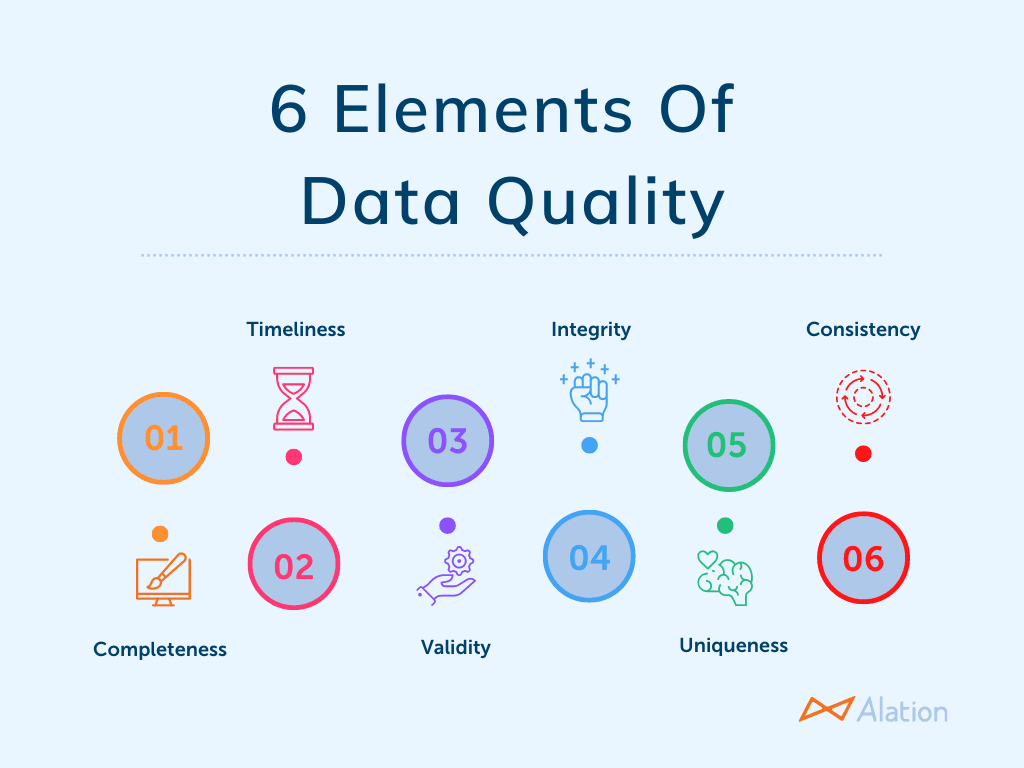
These dimensions are useful when evaluating the quality of a particular dataset at any point in time. Most data managers assign a score of 0-100 for each dimension, an average DQAF.
1. Completeness
Completeness is defined as a measure of the percentage of data that is missing within a dataset. For products or services, the completeness of data is essential in helping potential customers compare, contrast, and choose between different sales items.
For instance, if a product description does not include an estimated delivery date (when all the other product descriptions do), then that “data” is incomplete.
2. Timeliness
Timeliness measures how up-to-date or antiquated the data is at any given moment. For example, if you have information on your customers from 2008, and it is now 2027, then there would be an issue with the timeliness as well as the completeness of the data.
When determining data quality, the timeliness dimension can have a tremendous effect, either positive or negative, on its overall accuracy, viability, and reliability.
3. Validity
Validity refers to information that fails to follow specific company formats, rules, or processes. For example, many systems ask for a customer’s birthdate.
However, if the customer does not enter their birthdate using the proper format, the level of data quality becomes automatically compromised. Therefore, many organizations today design their systems to reject birthdate information unless it is input using the pre-assigned format.
4. Integrity
Integrity of data refers to the level at which the information is reliable and trustworthy. Is the data true and factual?
For example, if your database has an email address assigned to a specific customer, and it turns out that the customer actually deleted that account years ago, then there would be an issue with data integrity as well as timeliness.
5. Uniqueness
Uniqueness is a data quality characteristic most often associated with customer profiles. A single record can be all that separates your company from winning an e-commerce sale and beating the competition.
Greater accuracy in compiling unique customer information, including each customer’s associated performance analytics related to individual company products and marketing campaigns, is often the cornerstone of long-term profitability and success.
6. Consistency
Consistency of data is most often associated with analytics. It ensures that the source of the information collection is capturing the correct data based on the unique objectives of the department or company.
For example, you have two similar pieces of information: The date on file for the opening of a customer’s account and the last time they logged into their account.
The difference in these dates provide valuable insights into the success rates of current or future marketing campaigns.
Determining the overall quality of company data is a never-ending process. The most important habit in data quality management is catching problems early, before they reach a dashboard or an agent.
Understanding data quality intersections
When assessing data quality, it's important to consider how different aspects of quality can affect each other. For example, the completeness of data can impact its timeliness.
Incomplete data can fail to capture the full picture of events, impacting time to insight. Also, the accuracy of data can be linked to its reliability, especially if it doesn't follow certain rules. For example, a support ticket missing a product ID will force someone to manually trace it before analysis can start, causing delay.
Data quality management tools, software & best practices
Data is generated by people, who are inherently prone to human error. To avoid future problems and maintain data quality continuity, your organization can adopt best practices that will ensure the integrity of your data quality management system for years into the future.
Such measures include:
Establish employee and interdepartmental buy-in across the enterprise.
Set clearly defined metrics.
Ensure high data quality with data governance by establishing guidelines that oversee every aspect of data management.
Create a process where employees can report any suspected failures regarding data entry or access.
Establish a step-by-step process for investigating negative reports.
Launch a data auditing process.
Establish and invest in a high-quality employee training program.
Establish, maintain, and consistently update data security standards.
Assign a data steward at each level throughout your company.
Tap into potential cloud data automation opportunities.
Integrate and automate data streams wherever possible.
These aren't one-time actions, but rather the operational baseline that keeps data quality from degrading between audits. The next question is which tools actually support them at scale.
What to look for in data quality management software
The right data quality management software should reduce manual effort, not just report on problems after the fact. Look for:
Automated anomaly detection
Predefined and customizable quality rules
Real-time alerts and monitoring dashboards
Metadata and lineage tracking
Native data catalog integration
Forrester research found that more than a quarter of data and analytics professionals estimate their organization loses over $5 million annually to poor data quality. 3 Evaluating data quality management software against the list above avoids the common trap of buying a monitoring dashboard when what you actually need is automated resolution.
For a closer look at how catalog-embedded quality tools compare to bolt-on options, Alation & Bigeye's datasheet walks through real-time monitoring and proactive detection inside a live data catalog.
Data quality solutions: build vs. buy
Choosing between data quality solutions generally comes down these three approaches:
Standalone data quality tools: Standalone tools catch bad data, but in isolation. A failed check tells you a rule was broken, not what that data feeds or why it matters.
Observability platforms that monitor pipelines end-to-end: Observability platforms extend that visibility across pipelines, flagging breakages as data moves. But they still treat data quality as a separate system from the metadata that explains it.
Quality features embedded in a data catalog: Catalog-embedded quality closes that gap by tying rule violations directly to the lineage and metadata that explain why they matter.
Alation's Data Quality Agent takes the embedded approach. It surfaces and prioritizes quality issues using the same governed context that powers search, lineage, and AI agent access, rather than running quality checks as a disconnected system.
Data quality vs. data integrity
Data quality and data integrity are closely related concepts in data management, and are often used interchangeably.
Data quality ensures the overall accuracy, completeness, consistency, and timeliness of data, making it fit for its intended use. On the other hand, data integrity is a broader concept that encompasses data accuracy and security as a whole.
Data integrity has two sides: logical and physical. Logically, it ensures that related data in different tables stay correct and connected. Physically, it uses controls and security to stop unauthorized changes or damage to data.
Data quality | Data integrity | |
Asks | Is this data accurate and fit for use? | Is this data protected and structurally sound? |
Covers | Accuracy, completeness, consistency, timeliness | Logical consistency + physical security/backup |
Fails when | Values are wrong or missing | Data is altered, corrupted, or lost |
Data integrity also includes backups to keep data safe and recoverable in case of unforeseen events. While data quality makes data useful, data integrity keeps it safe and reliable in a system or database.
Useful and safe still isn't the whole picture, though. Two more disciplines decide who's accountable for that data and which version of it is actually true.
Data quality vs. data governance vs. master data management
These three disciplines overlap but answer different questions.
Strong data quality management programs need all three working together. Quality without governance has no enforcement mechanism, and governance without quality has nothing reliable to enforce.
Asks | Fails when | |
Data quality | Is the data accurate and fit for use? | Values are wrong, missing, or stale |
Data governance | Who's accountable, and what rules apply? | No one owns the problem |
Master data management | Which record is the single source of truth? | The same entity conflicts across systems |
The strongest data quality solutions treat all three as one connected system rather than separate initiatives.
Data quality with Alation
Data quality management is necessary, but not sufficient on its own. The harder problem is making sure the business context around that data stays accurate as it feeds into dashboards, reports, and AI agents making decisions with minimal human review.
That's the gap Alation's Intelligence Operating System (AIOS™) is built to close. It’s a platform that masters business meaning across data and AI systems, governs how agents use it, and improves that meaning continuously through the governance engine underneath it.
More than 40% of the Fortune 100 rely on Alation to keep that context governed. Data quality management supplies clean, validated data while AIOS governs the meaning attached to it.
The result is that the context an agent consumes is accurate, improving, and defensible.
Alation Data Quality prioritizes and monitors your most critical data automatically. It uses the same governed context that powers search, lineage, and agent access across the platform rather than as a disconnected point tool.
Start a conversation to see how governed data quality fits into your AI strategy.

Frequently Asked Questions
What are the 7 dimensions of data quality?
The most commonly cited seven are accuracy, completeness, consistency, timeliness, validity, uniqueness, and integrity. Different frameworks group these differently and this article's nine-characteristic list above adds reasonability and accessibility.
What are the six pillars of data quality?
The six pillars mirror the DQAF measurement framework covered above: completeness, timeliness, validity, integrity, uniqueness, and consistency. Each scored to give teams a quantifiable view of dataset health.
What are the 5 V's of data analysis?
Volume, velocity, variety, veracity, and value. It's a big-data framework rather than a data quality one specifically, but veracity (whether the data can be trusted) is where the two concepts meet directly.
How do you maintain data quality for AI agents operating at scale?
By treating quality as continuous infrastructure rather than a periodic audit. Static checks can't keep pace with agents querying live data. Quality signals need to flow into the same context layer the agent reads from, so degradation gets caught before an agent acts on it, not after.
What's the difference between data quality monitoring and data observability?
Monitoring checks specific rules against specific datasets (is this field complete, is this value in range). Observability is broader: it watches pipeline health, freshness, and lineage across systems to catch issues monitoring rules weren't written to anticipate. Most mature programs run both.
Sources & notes
Every external claim on this page is independently verifiable. The public sources are listed here.
Organizations in complex industries can spend up to 94% of their time preparing data for analytics and AI. Source: Gartner, cited in Google Cloud, October 25, 2024. https://cloud.google.com/blog/products/data-analytics/introducing-ai-driven-bigquery-data-preparation
Since at least 2018, State Farm has used algorithmic decision-making tools to screen homeowners' claims for fraud; a federal disparate-impact claim under the Fair Housing Act survived the company's motion to dismiss and the case is ongoing. — Civil Rights Litigation Clearinghouse, Huskey v. State Farm Fire & Casualty Co., No. 1:22-cv-07014 (N.D. Ill.). https://clearinghouse.net/case/44310/
More than a quarter of data and analytics professionals estimate losing $5M+ annually to poor data quality, and 7% report $25M+. Source: Forrester, "Millions Lost In 2023 Due To Poor Data Quality, Potential For Billions To Be Lost With AI Without Intervention," July 31, 2024. https://www.forrester.com/report/millions-lost-in-2023-due-to-poor-data-quality-potential-for-billions-to-be-lost-with-ai-without-intervention/RES181258
- Data Intelligence
- Data Quality
- Digital Transformation
- Enterprise Data Catalog
- Modern Data Stack
- Data Catalog
- AI
- Data Governance

Myles Suer
Keep reading
More from the data desk