

Most enterprises are now discovering that their AI programs fail for reasons that have nothing to do with their models. Gartner predicts that by 2027, 40% of enterprises will demote or decommission autonomous AI agents because of governance gaps, gaps that only became visible after a production incident.¹ The agents worked. The data underneath them wasn't governed well enough to trust what the agents did with it.
Data governance addresses this by creating clear structures for managing the accuracy, security, usability, and compliance of data across its lifecycle. When teams agree on how to manage, protect, and access data, they collaborate more effectively and get more value from enterprise information, and the systems built on top of that data behave predictably.
Organizations put these principles into practice by building a governance framework. A clear model helps assign ownership, apply policies consistently, and build trust in the data that drives decisions at every level. No single model fits the unique needs of every business, but proven frameworks offer a strong place to start.
The stakes for getting this right have grown sharply. As organizations deploy AI agents to automate decisions, generate analysis, and run business workflows, data governance has taken on a new role: it is now the infrastructure that determines whether AI produces outputs that are accurate, defensible, and safe to act on. An agent that consumes ungoverned data will make confident-sounding, wrong decisions at machine speed. A well-designed governance framework prevents that.
What is a data governance framework?
A data governance framework is a structured operating model that defines how an organization owns, classifies, secures, and shares its data. It specifies decision rights, roles, policies, and quality standards across the data lifecycle. Common frameworks include DAMA-DMBOK, COBIT, DCAM, and DGI, each optimized for a different problem: technical practice, IT risk, maturity benchmarking, or organizational design.
In practice, a framework does three things a set of good intentions cannot:
It makes governance decisions repeatable, so the answer to "who can approve access to customer data?" doesn't change depending on who is asked.
It makes governance auditable, so you can demonstrate to a regulator or a board that a control existed before an incident rather than after it.
And it makes governance scalable, so adding a new data domain or a new business unit doesn't require rebuilding the program from scratch.
A framework is the structure that determines how policy, ownership, and quality standards get applied to real data by real people, and, increasingly, by AI agents acting on their behalf.
Data governace framework vs. policy vs. strategy
These three terms are used interchangeably but have subtle differences. They describe different layers of the same program:
Data governance strategy is the why. It sets the business outcomes governance exists to serve (audit readiness, AI accuracy, faster analytics, reduced risk) and secures the mandate and funding to pursue them.
Data governance framework is the how. It defines the operating structure: roles, decision rights, pillars, processes, and the model you'll follow to connect them.
Data governance policy is the what. Policies are the specific, enforceable rules the framework produces: classification schemes, retention periods, access rules, quality thresholds.
You need all three, in that order. Teams that start with policies before choosing a framework tend to produce a stack of documents nobody applies consistently.
Comparing the most widely used data governance frameworks
Framework selection matters because different frameworks solve fundamentally different problems. Choosing one built for external audit when your actual constraint is AI readiness produces a program that satisfies nobody. The table below compares the models covered in this article, including how much work each one leaves you to do before AI agents can safely consume your data.
Framework | Best for | Primary focus | Typical adopters | Maturity required | AI-agent readiness |
DAMA-DMBOK | A technical roadmap across all data functions | Full data management lifecycle, 11 knowledge areas | All industries; teams building governance from scratch | Low to start, high to complete | Partial. Strong on metadata and quality, silent on agent evaluation |
COBIT | Tying governance to IT risk and audit readiness | IT governance, controls, risk mitigation | Financial services, regulated enterprises | Medium, assumes existing control functions | Limited. Control-oriented rather than context-oriented |
DCAM | Benchmarking maturity against industry peers | Capability assessment and roadmapping | Financial services, regulated industries | Medium to high | Partial. Good on lineage and controls |
CDMC | Governing data across cloud and hybrid estates | Cloud controls and cross-border compliance | Global, multi-cloud organizations | Medium | Partial. Strong on where data lives, light on what it means |
IBM maturity model | Assessing current state and planning improvement | 11 domains across 5 maturity levels | Large enterprises | Low, designed for assessment | Limited |
PwC framework | Connecting governance to enterprise risk management | Layered strategy-to-lifecycle alignment | Regulated, global companies | Medium to high | Limited |
It’s key to note that no framework on this list was designed for a world in which AI agents are primary consumers of enterprise data. Each still provides real value as a foundation, but each needs to be extended with the business context, certification signals, and evaluation loops that agents require to deliver accurate outputs.
3 examples of popular data governance frameworks
Choosing the right enterprise data governance framework gives your team a plan. It helps define roles, manage risk, and apply policies throughout the data lifecycle.
While organizations vary in structure and needs, these three foundational frameworks can guide effective implementation:
1. DAMA-DMBOK
The data management body of knowledge (DAMA-DMBOK) framework stands out as the most comprehensive source for data management best practices. It shows how governance links to other data functions. These functions include quality, architecture, integration, and metadata.
The framework offers several practical strengths:
Covers the whole data lifecycle in 11 areas, including data quality, metadata management, and data security
Maintains vendor neutrality and relies on proven theory, making it widely applicable
Places governance at the center of enterprise data strategy
Teams often treat DAMA-DMBOK as a starting point. They rely on it to create internal governance policies and train new stakeholders.
2. COBIT
The control objectives for information and related technologies (COBIT) framework originated in the IT space but has become a strong framework for broader information governance. Organizations that already use formal risk, compliance, or control systems can adopt it more effectively, making it a popular choice for financial service institutions.
COBIT offers the following key advantages:
Aligns IT and data policies with business objectives
Provides strong guidance on risk mitigation and control monitoring
Breaks objectives into clearly structured domains and processes
For organizations with formal audit or critical data element requirements, COBIT brings governance into sharper focus.
3. DCAM
The EDM Council created the data management capability assessment model (DCAM) to introduce a global standard framework for managing data to drive strategic value. It helps leaders grasp how data governance practices are supporting privacy, compliance, and security. Then, it helps you choose what to focus on next.
This framework offers these benefits:
Allows benchmarking against industry norms
Maps to key regulations like BCBS 239 (which is critical in finance)
Provides a roadmap for capability development over time
Teams in financial services and other regulated areas often use DCAM for its balance of rigor and flexibility.
Other influential models and custom frameworks
Many consulting and tech firms have created governance models for specific industries. These models meet unique regulatory needs and support various transformation goals.
The cloud data management capabilities (CDMC) framework comes from the EDM Council. It provides clear controls and best practices for managing data in cloud and hybrid environments. It's especially relevant for global organizations that operate across different regulatory environments.
IBM's data governance maturity model features 11 governance domains and five maturity levels. It helps large companies evaluate their current status and create clear improvement plans.
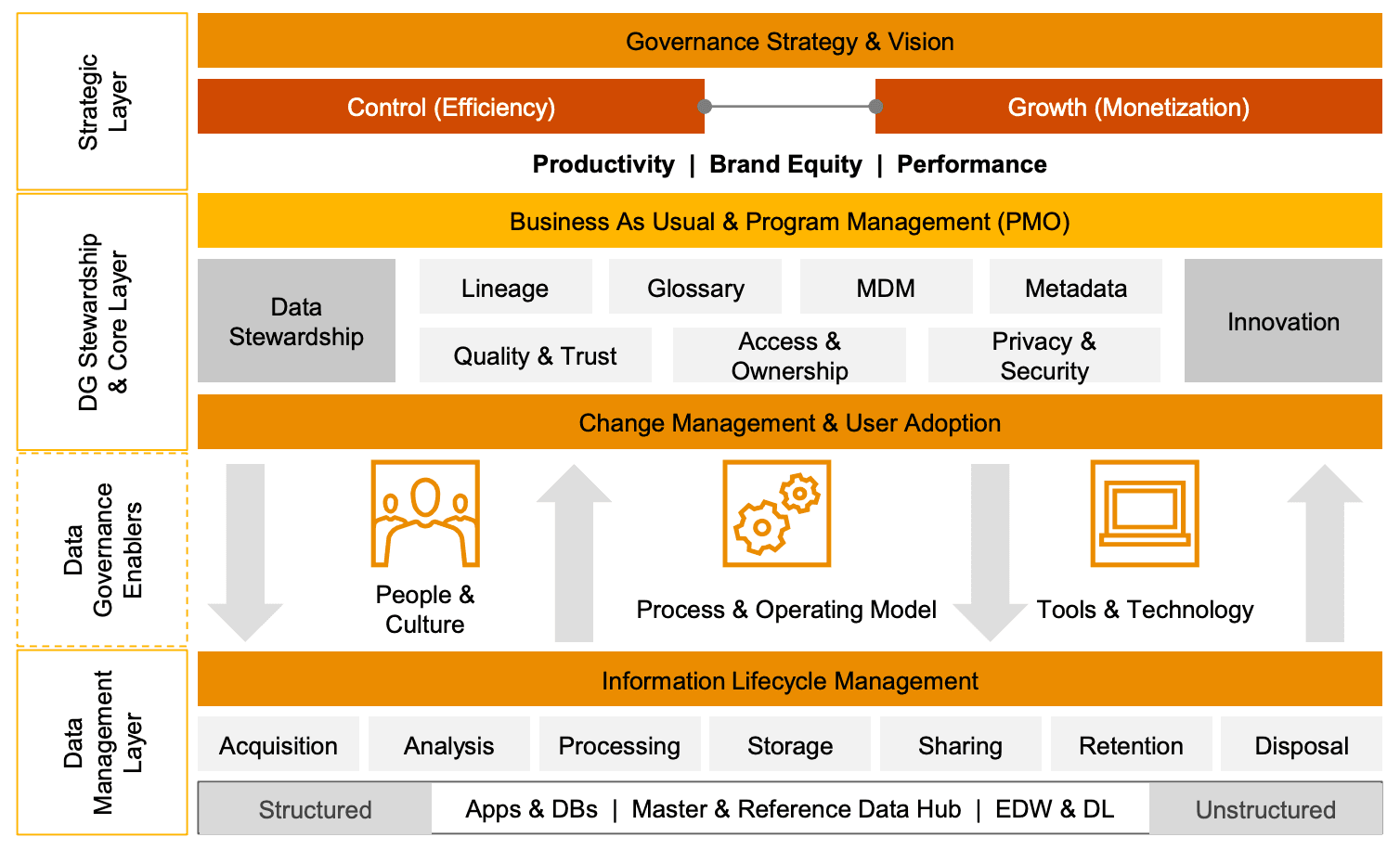
PwC's data governance framework helps businesses in regulated industries. It connects data governance with enterprise risk management for global companies.
The diagram below illustrates PwC's data governance framework in action. It breaks governance into five layers, connecting high-level strategy with detailed data lifecycle activities to support enterprise-wide alignment.
How to choose the right framework for your organization
Choose a data governance framework by matching it to your primary constraint. Pick DAMA-DMBOK for technical breadth, COBIT for audit and IT risk, DCAM for maturity benchmarking in financial services, DGI for decision rights and org design, and CDMC for multi-cloud estates. Most enterprises blend two: one technical core, one business-facing layer.
Start from your binding constraint, not your ambition
The most common selection error is picking the most comprehensive framework rather than the most relevant one. DAMA-DMBOK covers more ground than any other model on the list, which makes it the default choice for teams who want to be thorough. But if your board is asking about audit findings, or your CISO is asking about cross-border data residency, or your AI team is asking why an agent returned three different revenue numbers, thoroughness is not what you need first. You need the model that speaks directly to the question you are being asked.
Write down the single sentence you would use to justify governance spend to your CFO this quarter. The framework that maps most cleanly to that sentence is your starting point.
Use a core-and-edge pattern
Very few mature programs run on a single framework. The pattern that holds up in practice is a technical core paired with a business-facing edge.
The core is the model your data team works from day to day: usually DAMA-DMBOK, sometimes DCAM in financial services. It gives practitioners a complete vocabulary and a defensible structure for quality, metadata, lineage, and stewardship work.
The edge is the layer that translates that work into business language: DGI for decision rights and accountability, or PwC when governance needs to plug into enterprise risk management. The edge is what your governance council and your executive sponsor actually see.
Running only the core produces a technically sound program nobody outside the data team can evaluate. Running only the edge produces an org chart with no operating substance underneath it.
Three questions to settle before you commit
What has to be true in 12 months? Audit readiness, AI agent deployment, and analytics self-service are three different destinations, and they favor different models.
What is your honest current maturity? DCAM and COBIT assume functioning control and risk practices already exist. Adopting them into an organization without those practices creates a documentation exercise rather than a governance program.
Who has to carry it? A framework that your stewards find unusable will be abandoned regardless of how well it maps to the regulatory environment. Test the vocabulary on the people who will use it before you standardize on it.
Finally, expect to customize. Every framework on the comparison table is a reference model, not a specification. Organizations that adopt one wholesale, without adapting terminology and scope to their own structure, are the ones most likely to abandon it within two years.
6 key pillars for consistent data oversight
A strong data governance framework relies on the following core pillars:
1. Data quality management
Data quality management sets the standards and processes that maintain accuracy, completeness, and consistency across your data ecosystem. It relies on automated quality checks, standard data definitions, and systems that track quality metrics over time.
Without strong data quality management, even the most sophisticated AI models produce unreliable results. This connection runs deeper than model training. AI agents running live business workflows, retrieving data, making recommendations, and triggering actions, depend on current, certified data to produce outputs worth trusting. Data quality management and a robust evals system keep those agents accurate as data evolves.
2. Data privacy and security
Data privacy and security protect sensitive information through four controls working together:
Strong encryption to prevent unauthorized access during storage or transmission.
Access controls that ensure only verified users can interact with protected data.
Secure architectures that reduce exposure to cyber threats across systems and networks.
Compliance safeguards that align with data privacy regulations such as GDPR, HIPAA, and CCPA. These controls ensure lawful processing, consent management, and audit readiness.
A strong privacy program keeps personal and regulated information safe by letting only authorized users access this data.
3. AI readiness and agent governance
AI readiness and agent governance determine whether the data in your environment is safe for autonomous systems to act on. As AI agents become participants in enterprise workflows alongside human analysts, governance frameworks play a key role in helping agents consume and act on data. This means documenting not just what data exists and who owns it, but what it means, how it should be used, and whether the outputs agents produce with it can be traced and explained.
This is the distinction between AI governance, tracking which models are deployed and whether they meet compliance requirements, and governed AI, ensuring the knowledge agents consume is accurate, current, and defensible. Both matter, but governed AI is the harder problem, and it's where most enterprises underinvest. A mature governance framework addresses both.
4. Data stewardship and accountability
Data stewardship assigns clear ownership of data assets and ensures they are properly managed throughout their lifecycle. It defines who has the authority to make decisions about access, quality standards, and usage policies.
By clarifying these responsibilities, stewardship helps organizations maintain accountability and consistency in how they handle data.
➜ To learn more about setting up a strong team structure, check out how organizations build effective governance teams.
5. Data lineage and transparency
Data lineage maps how information flows across systems and processes. By tracking changes and relationships between sources, lineage builds trust in how data evolves over time.
Teams use lineage to trace data origins, understand transformations, and spot downstream impacts that could affect accuracy or compliance.
6. Policy and standards management
Policy and standards management gives mature governance programs clear governance policies that guide how data is classified, stored, retained, and used. These policies define responsibilities across departments and support regulatory compliance.
To maintain consistency, strong policy management aligns teams around shared definitions and decision-making roles. As data volumes grow, this structure helps governance efforts scale effectively.
Together, these six pillars form a complete governance foundation. Gaps in any one of them show up elsewhere: as poor data quality, security exposure, compliance findings, or AI outputs nobody can defend.
How to successfully develop and implement a data governance framework
To build a sustainable data governance program, you can follow these key steps.
Step 1: Assess current state
Begin by conducting a thorough audit of your existing data assets, processes, and governance practices. This assessment will reveal your data, its storage locations, and current management methods. It will also highlight any gaps in governance.
For example, a financial services company might find customer data in 15 separate systems. These systems can have varying formats, conflicting definitions, and uncertain ownership. This assessment provides the baseline understanding that's necessary for designing targeted improvements.
Step 2: Define governance scope and objectives
Once your current state assessment is complete, align governance efforts with business goals and AI readiness. Rather than trying to manage all data at once, prioritize critical data elements that affect business operations, regulatory needs, or strategic plans, especially those involving sensitive information like personal identifiers or financial records.
Starting small helps you stay focused and build momentum. Matt Sullivan, director of technical account management at Alation, explains his approach to launching a governance framework: "You start off small with a small set of data and a small set of policies, and then eventually you mature out to more robust processes and tackle additional data domains."
If AI readiness is a near-term priority, and for most enterprises in 2026 it is, the governance scope should explicitly include the data assets that AI agents will consume. That means prioritizing not just data quality and access controls, but business definitions, certification status, and the institutional context agents need to reason accurately. An agent that can find the data but doesn't know which definition of "revenue" applies will produce answers that are fast and wrong.
As you mature your governance program, support that growth with measurable goals tied to business impact. Avoid vague targets like "improve data quality." Instead, use specific metrics, such as "cut customer data inconsistencies by 75% in six months," to demonstrate value and guide improvements.
➜ For help aligning governance scope with business goals, explore this guide on building a data governance strategy.
Step 3: Choose and customize the framework
Next, choose the governance framework that suits your industry needs, company structure, and rules. Most organizations customize their chosen framework rather than implementing it exactly as designed. The comparison table above is a useful starting point for narrowing the field.
Many teams over-engineer their initial implementation, making it too complex from the start. It's better to begin with a few core governance capabilities and expand gradually, rather than attempting to apply every part of the framework at once.
Step 4: Establish governance structure
With a thoughtful framework in place, move on to planning a governance structure. Form a data governance council with representatives from business units, IT, legal, and compliance teams. This council must have clear power to make decisions on data policies. It should also resolve conflicts and allocate resources for data governance.
To support the council's work, assign data stewards and owners throughout your organization. These roles ensure that governance decisions are carried out effectively at both strategic and operational levels. Data owners typically oversee specific domains, while data stewards handle day-to-day tasks like quality monitoring and policy enforcement.
Step 5: Implement policies and technology
Beyond defining who should be involved in governance, it's also important to create comprehensive data governance policies that cover key areas such as:
Data classification: Define which data is sensitive or confidential and how it should be handled
Access controls: Set rules for who can view, edit, or share specific types of data
Quality standards: Establish benchmarks for accuracy, completeness, and consistency
Retention requirements: Outline how long to store data and when to archive or delete it
Next, set up workflows to manage common governance tasks. This includes processing data access requests, resolving quality issues, and coordinating between teams.
Use data governance tools to support these efforts. They can automate enforcement, monitor compliance, and offer self-service options for data users. However, your team must know how to use these tools effectively and how to maintain compliance with your policies, so the process doesn't end here.
Step 6: Train and monitor
Stakeholders need to understand new data governance processes and how those changes support both their work and broader organizational goals. This requires clear communication about what's expected of them and why it matters. To build long-term engagement, you need to invest in ongoing training programs. These can cover evolving regulations, policy changes, and emerging governance challenges.
Alongside training, it's important to monitor governance performance using clear KPIs. These governance metrics should reflect both compliance and business impact, such as policy adoption rates, data quality scores, and access request turnaround times.
6 common data governance framework challenges
Most data governance frameworks fail for organizational reasons rather than technical. The problems below account for the majority of stalled programs:
Challenge | What it looks like | How to counter it |
Over-engineering the rollout | Every component of the framework is implemented at once. Stewards disengage before the first domain is fully governed. | Scope phase one to a single high-value domain and a small set of policies. Prove it, publish the result, then expand. |
Misalignment with business needs | Governance optimizes for compliance while the business asks for speed, so the program reads as friction rather than enablement. | Involve business stakeholders during customization, not review. Tie every objective to a named outcome and a sponsor who owns it. |
Cultural resistance | Line leaders treat governance as a brake on innovation. Shows up as quiet non-adoption, not open objection, so it surfaces late. | Lead with pain people already feel: conflicting reports, slow access approvals, AI answers nobody trusts. Publish specific wins. |
Tool and platform incompatibility | The framework assumes capabilities your stack lacks, or tooling reaches one platform while data spans several. | Map framework requirements against current tooling before committing. Prioritize capabilities that work across platforms, not inside one. |
Inconsistent adoption across units | Some departments implement, others ignore. Definitions diverge and you end up with several partial programs instead of one. | Run a federated model: central standard, local flexibility. Make adoption visible through shared KPIs so gaps surface early. |
Shortage of skilled practitioners | Implementation needs data management, governance, and change management expertise at once. Most teams have the first only. | Train and certify existing staff rather than hiring the whole capability. Automate repetitive work so scarce time goes to judgment calls. |
Two patterns run through the whole table. The failures are organizational rather than technical, and they compound quietly, becoming visible only once adoption metrics flatten or a domain owner stops attending council meetings. Build the detection into your governance KPIs from the start, because a program that measures only data quality scores will not see any of these arriving.
What governance actually means in the age of AI agents
The purpose of data governance hasn't changed; it's still focused on ensuring that data is accurate, trusted, accessible, and used appropriately. What has changed is who is consuming that data and the speed and scale at which decisions get made.
When an analyst makes a mistake because she used the wrong dataset, a manager catches it in review. When an AI agent makes the same mistake across thousands of automated decisions before anyone notices, the impact is an order of magnitude larger. Governance has always mattered; in agentic AI environments, the cost of poor governance is immediate and compounding.
This is driving a new way to think about what an effective governance framework needs to deliver:
Sovereign governance means your organization's data knowledge (definitions, policies, lineage, trust signals) exists independently of any single data platform or vendor. As enterprises run data across Snowflake, Databricks, cloud storage, SaaS applications, and more, governance that only reaches one platform is governing a fraction of the estate. Sovereign governance travels with the data.
Fluid governance means metadata and business context move freely across platforms so that knowledge created in one system enriches every other system that needs it. An agent querying Databricks should have access to the same certified definitions and policies as one querying Snowflake. Governance that is siloed by platform creates inconsistency agents can't resolve.
Compounding governance is the capability that separates a governance framework from a governance snapshot. When agents consume governed data, get evaluated on their outputs, and those evaluations feed back into improving the underlying business context, the governance layer gets more accurate over time. This feedback loop, running from agent output to governance improvement, is what transforms a one-time compliance exercise into a durable competitive advantage.
Most traditional governance frameworks were designed for the first two. The third is new, and it's what modern frameworks need to build toward.
How Alation supports real governance in practice
Alation's approach to governance is built for both audiences that depend on it: the data teams and business users who need to find and trust data, and the AI agents that those teams are building and deploying. Our platform governs not just the data itself but the knowledge that makes data usable (definitions, policies, institutional context, and trust signals) across every platform in your environment.
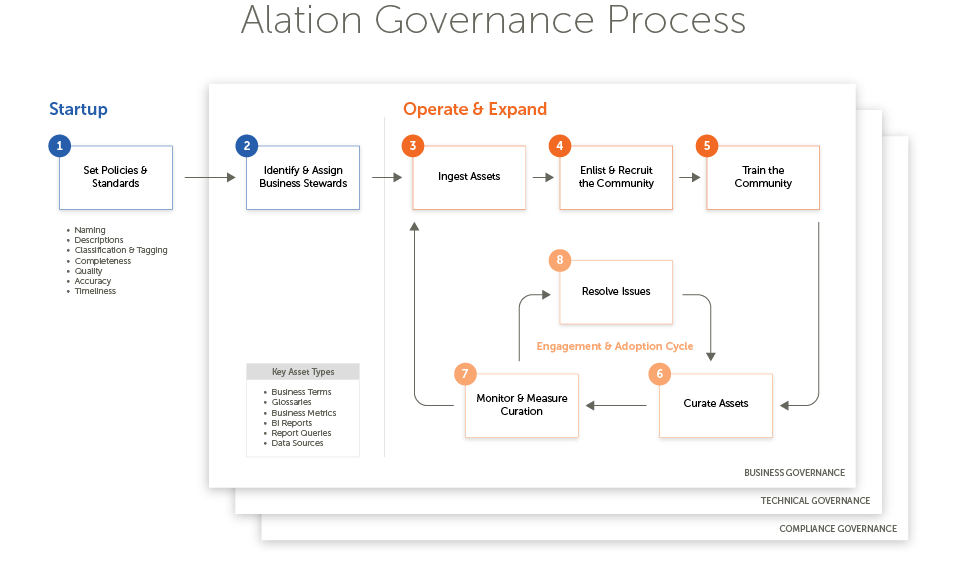
Five capabilities map directly to the framework requirements described above:
Capability | Framework requirement it satisfies |
Agent Studio builds, tests, and deploys AI agents on governed data products, with evaluation frameworks that measure whether outputs are accurate enough to act on and write findings back into the governance layer. | AI readiness and agent governance (pillar 3); compounding governance |
Data Products Marketplace packages trusted, governed data for broader business use, ensuring semantic consistency and a more accurate foundation for AI use cases. | Scope definition (step 2); AI readiness (pillar 3) |
Data Quality Agent identifies your most valuable data, monitors it, and automatically suggests and applies tailored rules you can modify. | Data quality management (pillar 1) |
Documentation Agent translates technical data context into business language and proposes descriptions people can approve or refine. | Policy and standards management (pillar 6); practitioner capacity (challenge 6) |
Lineage and usage insights show how teams use data and follow policies, supporting both daily operations and audits. | Data lineage and transparency (pillar 5) |
Alation treats governance not as a compliance layer but as the knowledge engine that makes both human analysts and AI agents more accurate over time. The more your organization uses it, the more accurate your governance becomes, and the more trustworthy your AI.
Frequently asked questions
Is a data governance framework the same as a data governance policy?
No. A framework is the operating structure that defines roles, decision rights, and processes. A policy is one of the enforceable rules that framework produces, such as a classification scheme or a retention period. The framework decides who sets policy and how; policies are the output.
Which framework is best for governing AI?
No single data governance framework covers AI risk completely. Most organizations pair a data governance framework such as DAMA-DMBOK with an AI-specific model: the NIST AI Risk Management Framework for voluntary risk practice, or ISO/IEC 42001 for a certifiable AI management system. The data framework governs inputs; the AI framework governs the systems consuming them.
What is the NIST AI Risk Management Framework?
The NIST AI RMF is a voluntary, non-certifiable framework organized around four functions: govern, map, measure, and manage. It is widely used in the United States as a structuring device for AI risk programs. It complements rather than replaces a data governance framework, since it assumes governed, documented data already exists upstream.
Do we need ISO/IEC 42001 if we already have a data governance framework?
Not necessarily. ISO/IEC 42001 specifies a certifiable AI management system, which matters most when customers, regulators, or procurement teams require independent attestation. If your AI use is internal and low-risk, extending your existing data governance framework to cover agent inputs and evaluations may be sufficient for now.
How does the EU AI Act change data governance framework requirements?
The Digital Omnibus on AI, Regulation (EU) 2026/1744, entered into force on July 27, 2026 and deferred high-risk obligations for Annex III systems from August 2026 to December 2, 2027, and Annex I systems to August 2028.² Article 50 transparency duties, GPAI obligations, and the prohibited-practices regime were not deferred. Treat the extension as scope-planning time, not relief.
How long does it take to implement a data governance framework?
A first governed domain typically takes three to six months, covering assessment, scope definition, council formation, and initial policies. Enterprise-wide coverage takes considerably longer and is better measured by domains governed than by calendar time. Programs that promise full coverage in a single year usually deliver documentation rather than adoption.
Do smaller organizations need a formal framework?
Yes, but a lighter one. Smaller organizations rarely need the full DAMA-DMBOK structure. What they do need is explicit ownership of critical data, documented definitions, and access rules that survive staff turnover. Start with the pillars rather than the framework, and formalize the model as complexity grows.
What is the difference between AI governance and governed AI?
AI governance tracks which models are deployed and whether they satisfy compliance requirements. Governed AI ensures the knowledge those systems consume is accurate, current, and defensible. Most organizations invest heavily in the first and underinvest in the second, which is why agents pass compliance review and still return unreliable answers.
Moving forward with your data governance roadmap
Developing or improving a data governance framework isn't a one-time task, since your framework should evolve as your organization does. While you don't need a complex program to get started, you will need to begin with clear goals, a focused scope, and a commitment to ongoing improvement.
As your organization grows, modernizing outdated processes becomes essential for a sustainable data governance initiative. Adopting data governance best practices like assigning data owners or reviewing access controls can help you create repeatable processes and streamline daily operations.
Today, the organizations moving fastest with AI share a common characteristic: they invested in data governance before they needed it for AI. Their catalog was mature, their definitions were certified, their lineage was documented. When agents arrived, they had a foundation to build on. For organizations still developing that foundation, the urgency is real, but so is the opportunity. A governance framework built today for both human analysts and AI agents will compound in value as agentic AI becomes a larger part of how work gets done.
The question to ask of any governance framework is not just "does it help us stay compliant?" but "does it make our AI more accurate, more defensible, and more trusted over time?" A framework that answers yes to both is the one worth building.

Sources & notes
Gartner, "Gartner Says Applying Uniform Governance Across AI Agents Will Lead to Enterprise AI Agent Failure," press release, May 26, 2026. https://www.gartner.com/en/newsroom/press-releases/2026-05-26-gartner-says-applying-uniform-governance-across-ai-agents-will-lead-to-enterprise-ai-agent-failure
Cloud Security Alliance, research note on the Digital Omnibus on AI and the revised EU AI Act high-risk timeline, 2026. https://labs.cloudsecurityalliance.org/research/csa-research-note-eu-ai-act-high-risk-deadline-omnibus-20260/
- Active Data Governance
- Data Intelligence
- Digital Transformation
- Engineering
- Enterprise Data Catalog
- Data Quality
- Data Governance
- Data Catalog
- AI
Keep reading
More from the data desk