


For data leaders, AI governance in 2027 is no longer just a compliance checkbox; it now directly drives financial and operational outcomes. Yet many organizations still try to retrofit governance after deploying AI models, a mistake that leads to inaccurate outputs, inflated costs, and regulatory exposure. 8 Enterprises that govern proactively see measurable returns instead. 9
The reason many programs fall short is that they conflate two distinct problems under one label:
AI governance (the compliance problem): tracking which models are deployed, which regulations apply, and whether documentation is complete. The EU AI Act, NIST AI RMF, and ISO 42001 aren't optional, and every vendor now sells a solution here.
Governed AI (the accuracy problem): ensuring the knowledge agents consume (business definitions, data quality signals, semantic models) is accurate and defensible across every platform. An agent can pass every compliance check and still produce confident, wrong answers if it draws from ungoverned semantic models.
Most enterprises overinvest in the first and underestimate the second.
This guide dives into both AI governance and data governance, and why they are critical practices for every business. Plus, dive into common AI governance frameworks and learn best practices for your organization.
Key takeaways
AI data governance is essential for value realization. It connects high-quality data assets and well-documented training data with ethical, explainable models to deliver trustworthy AI aligned to business objectives.
Data quality, lineage, and governed semantics are non-negotiable. Reliable data sources, end-to-end lineage, and consistent semantic model definitions across platforms directly impact both agent accuracy and audit readiness — and must be governed independently of any single data platform.
Mature AI governance frameworks drive financial results. Research indicates companies with advanced data governance strategy and AI governance frameworks outperform peers—especially when data culture and stewardship are strong.
Leadership and roadmap matter. CEOs, CIOs, and CDAOs must sponsor a cross-functional roadmap that aligns regulatory requirements (EU AI Act, GDPR, CCPA, NIST) with operational excellence and innovation.
Governance reduces AI risk and builds trust. Proactive controls for data privacy, personal data, and sensitive data reduce exposure, enable transparency, and accelerate compliant, repeatable innovation.
AI governance can't stand alone. It depends on data governance as its foundation — a model can be technically compliant on paper and still produce biased or unreliable outputs if the data feeding it was never properly governed in the first place.
What is AI governance?
AI governance is the set of policies, processes, roles, and technologies that ensure AI systems are built, trained, deployed, and monitored using high-quality, secure, and ethically managed data.
A second dimension of this defintion that's equally critical for enterprises deploying AI agents at scale is this: governing the knowledge those agents consume at runtime. A governed AI agent must have access to semantic models that are consistent across platforms, business definitions that are certified and current, and a feedback loop that makes its outputs more accurate over time. The best practices in this post address both dimensions.
More deeply, AI data governance extends a modern data governance strategy to the world of artificial intelligence and machine learning. It unites metadata, data lineage, access controls, and quality management with AI-specific practices—like model documentation, bias testing, explainability, and human oversight—so that models trained on complex training data behave responsibly and predictably in production. It also ensures that personal data and other sensitive data are handled according to data privacy laws and organizational risk tolerance.
For example, a retailer deploying a chatbot to answer customer questions needs to classify data sources, validate training data, enforce least-privilege access to personal data, log prompts and outputs, and monitor for drift and toxicity. AI data governance provides the repeatable guardrails so the chatbot remains accurate, compliant with regulatory requirements (e.g., CCPA), and aligned to business objectives over time.
The same logic holds outside of retail. A healthcare organization deploying an AI triage tool needs more than a model audit, it needs governed patient data, documented lineage back to the source system, and clear accountability for who approved the model for clinical use.
Where data governance manages the raw material, AI governance manages what's built on top of it: the models, the agents, and the decisions they make.
AI vs data governance: Similarities and differences
Both AI governance and data governance are essential—and complementary. Data governance ensures data assets are fit for purpose; AI governance ensures models that consume that data act responsibly and deliver reliable outcomes. Together, they create an ecosystem of accountability that is indispensable in today’s AI-driven enterprise.
Where they overlap and diverge
Dimension | Data governance (DG) | AI governance (AIG) |
Primary focus | Quality, availability, ownership, and protection of data assets and data sources | Safety, performance, fairness, and accountability of AI technologies and ML models |
Core artifacts | Business glossary, data catalog, stewardship assignments, policies, data lineage | Model registry, model cards, data sheets, decision logs, testing protocols |
Key controls | Data quality rules, access controls, retention, CCPA/GDPR privacy controls | Explainability, bias testing, model risk classification, human-in-the-loop, kill-switches |
Compliance anchors | Data privacy & security (e.g., GDPR, CCPA), records management | Model governance (e.g., EU AI Act), NIST AI Risk Management Framework, sector rules |
Operations | Stewardship workflows, issue remediation, and provenance tracking | Registration → approval → monitoring → versioning → rollback → retirement |
Metrics | Completeness, accuracy, timeliness, access violations | Fairness, drift, robustness, interpretability, incident rate, audit readiness |
Agent accuracy | Governs the data assets that agents query (quality, lineage, trust) | Governs the semantic models and business definitions agents use to reason (consistency, certification, cross-platform sync) |
Why both are needed: Data governance ensures the data inputs are trustworthy; AI governance ensures the outputs—predictions, insights, and actions—are reliable, explainable, and aligned with human values. By providing a framework for development, AI governance also supports versioning and ongoing optimization.
By providing a framework for development, AI governance also supports versioning and ongoing optimization. Leaders need a disciplined versioning regimen (models, features, prompts, and training data) with continuous monitoring for drift, bias, and performance. This view allows teams to track how changes to AI models impact the outputs, compare releases against baselines, and rollback to earlier versions when a new deployment introduces regressions or AI risk.
What are data governance best practices?
Data governance best practices are the foundational controls — clear ownership, enforced quality standards, classification, lifecycle management, and documentation — that every AI governance program is built on top of.
Before diving into AI-specific frameworks, it's worth grounding in the data governance best practices that every AI governance program is built on top of. More than a checklist, these are foundational principles that help data leaders maintain control, ensure accuracy, and deliver value from enterprise data:
Define clear roles and responsibilities. Appoint Data Owners, Data Stewards, and Data Product Managers. These roles create accountability for quality, access, and usability. Data Product Managers in particular serve as the connective tissue between business users and technical teams, owning datasets as products and ensuring they meet organizational needs.
Develop a data governance framework. Choose a model that fits your organization's structure and culture. Centralized frameworks suit highly regulated industries, while decentralized or federated models promote autonomy. Hybrid models are growing in popularity for balancing control and flexibility.
Develop and enforce data quality standards. Set rules for accuracy, completeness, uniqueness, and consistency across the data lifecycle. Use reference data, business rules, and validations to automate enforcement where possible.
Implement data classification schemes. From public to restricted, identify and categorize data based on sensitivity and usage so appropriate access, handling, and retention protocols are applied.
Launch data lifecycle management processes. Track data from creation through archival or deletion. Apply automated workflows to manage retention policies, compliance requirements, and audit trails.
Collaborate across departments. Break down silos and involve stakeholders from every function. Marketing, sales, finance, and operations all produce and consume data. They should each share responsibility for governance.
Maintain comprehensive documentation. Data dictionaries, business glossaries, and metadata repositories help users find, understand, and trust data. Modern catalogs powered by AI and automation simplify documentation and encourage reuse.
Use automated tools for data quality assessment and remediation. Platforms like Alation's Data Quality Agent proactively scan for data anomalies and help teams resolve issues before they impact business outcomes.
Establish issue resolution processes. Set up clear workflows and escalation paths for data conflicts. Encourage transparency and build a shared understanding of data definitions and lineage.
Implement strong data security and privacy protocols. Incorporate role-based access, encryption, and monitoring. Stay ahead of evolving regulations like GDPR, CCPA, and emerging AI-related legislation.
Continuously monitor and update policies. Governance isn't static. New tools, use cases, and regulations will emerge. Build governance into change management processes to adapt without friction.
These practices form the foundation. As AI systems increasingly run on top of that data, they need a layer of practices all their own.
Why is AI governance critical today?
AI governance matters now because the exposure is already live: AI is making or influencing decisions on tools most enterprises have not inventoried, against data they have not certified. This discipline now sits at the intersection of compliance readiness, repeatable innovation, and risk reduction with transparency.
Being audit-ready and compliant by design
Organizations must be prepared to demonstrate how AI systems meet regulatory requirements, including the EU AI Act, the CCPA, sector-specific rules, and best-practice frameworks such as NIST’s AI Risk Management Framework.
Audit readiness means you can show what training data was used, how personal data and sensitive data are protected, which data sources inform decisions, and how explainability and human oversight are implemented. Compliance-by-design streamlines audits, reduces fines, and fosters trust with regulators and customers.
Creating a system for optimizing models and scaling innovation
Governance is a system for improvement—not just a gate. With governance features such as registries, model documentation, data lineage, and A/B evaluation practices, teams can continuously optimize LLM prompts and machine learning models, reuse curated features, and standardize evaluation across use cases. The result is repeatable innovation: faster iteration cycles, lower rework, and consistent performance across chatbot, forecasting, and recommendation use cases.
Reducing risk and bias while enabling accountability and trust
Bias, hallucination, data leakage, and privacy violations are not edge cases—they’re predictable AI risks. Proactive controls (data minimization, differential privacy, RBAC, prompt/content filters, human-in-the-loop) and transparent documentation (model cards, decision logs) enable accountability. When stakeholders can see how systems are trained, tested, and monitored, they’re more likely to trust the outcomes.
Missing opportunities without governance
Despite record AI adoption, governance remains underdeveloped. “According to a 2024 Gartner poll, 55% of organizations report having a dedicated AI board. Meanwhile, a 2025 EY survey found that only about one-third of companies say they have responsible controls governing their AI models. This oversight leads to compliance failures and wasted investments. Without defined guardrails, organizations encounter errors, bias, and inefficiencies that diminish AI’s potential.
A senior data governance leader captured it well:
“We scratch our heads and say, ‘What data are you looking at? Where is this going? Who has access to this?’ By the time it gets to production, it’s sometimes too late, and we just have to make it work.”
Companies that fail to invest in governance up front pay the price later in lost opportunity and rework.
Boosting financial outcomes
The argument for AI governance isn’t theoretical—it’s financial. Research shows that organizations with mature AI and data governance frameworks outperform peers by 21–49%, with improvements as high as 54% among those that also advance data culture maturity.
Consider GXS Bank, a digital bank in Singapore that leverages alternative data to expand credit access. As Chief Data Officer Dr. Geraldine Wong explains:
“There’s a lot of skepticism about what AI can do. We need to trust the data that goes into the AI models. If organizations and their customers are able to trust the data that the organization is using for such models, then I think that’s a good starting point to building that trust for AI governance or responsible AI.”
Trustworthy data, reinforced by governance, isn’t just a compliance goal; it’s a growth strategy.
This same shift is visible in how leading data teams talk about governance itself: as an offensive strategy rather than a purely defensive one. One of the world's largest footwear retailers, used a modern data catalog to establish a single source of truth for KPIs, cut change-management time from three months to under one week through better lineage, and streamlined a Snowflake migration by identifying redundant datasets.
A 2025 TDWI report notes that governance remains one of the persistent challenges organizations face when scaling self-service analytics 6, which is exactly the gap a proactive, catalog-driven approach closes.
Executive focus: why CEOs and CIOs must prioritize AI governance
According to a 2025 study by IDC and NetApp, organizations classified as ‘AI Masters’—those with advanced data governance, infrastructure modernisation and security integration—achieved:
~24.1 % higher revenue growth than less-mature peers.
~25.4 % greater cost-efficiency compared to less-mature peers.
This is why AI governance is a boardroom issue, not a back-office function. CEOs and CIOs must lead from the top, ensuring governance aligns with the company’s strategic, ethical, and financial objectives.
The consequences of neglecting governance are growing. Citigroup, for instance, was fined $136 million for failing to remediate longstanding data management issues. In the AI era, similar lapses can result not only in fines but also loss of customer trust.
Conversely, enterprises that treat governance as a growth enabler gain a durable competitive advantage. Governance maturity translates directly into agility, cost efficiency, and resilience—hallmarks of successful AI-driven organizations.
What are the core pillars of AI data governance?
AI governance rests on four pillars: data quality management, metadata as the control surface for augmented governance, security and privacy, and ethical AI. Each addresses a different failure mode like bad inputs, invisible context, exposure, and bias. All four have to hold together for AI systems to be trustworthy in production.
Data quality management for AI
At the heart of every successful AI initiative lies not just clean data, but AI-ready data — data that’s accurate, representative, and aligned with the specific use case. As Gartner’s How AI-Ready Data Drives AI Success explains, “AI-ready data must be representative of the use case — of every pattern, error, and outlier needed to train or run the model.”
In other words, quality is not about perfection; it’s about representation. Models trained on overly sanitized or incomplete data risk producing biased, unreliable, or misleading results. AI can identify patterns, but it cannot turn unfit or unrepresentative data into sound decisions.
To ensure optimal performance:
Data profiling and validation: Use automated profiling, anomaly detection, and data contracts to surface issues early.
Make AI lineage traceable: Provide end-to-end data lineage from datasets to models and outputs; catalog LLM prompts, features, and model artifacts in a single source.
Centralize metadata: Keep tags, policies, quality indicators, and stewardship assignments in a data catalog where they are searchable and governed.
Data quality is not the sole responsibility of technical teams — it’s a shared enterprise duty. Governance must make stewardship explicit and accountability transparent, ensuring that every stakeholder contributes to maintaining data that’s not just clean, but truly AI-ready.
Augmented governance: metadata as the control surface
A key enabler of scaling DQ for AI is metadata. In AI-enabled environments, metadata (data about data) becomes the control surface for governance itself, giving organizations the context needed to understand, trust, and control how data is used. This lets teams:
Track the full lineage of data used to train or feed AI models
Monitor data usage patterns and flag anomalies in consumption
Understand data provenance to support explainability and transparency
Automate policy application and classification based on metadata attributes
Improve the discoverability of datasets that meet governance and performance thresholds
This is the rise of what's sometimes called augmented governance: AI agents working alongside human governance teams to identify data quality anomalies in real time, automate classification and sensitivity labeling, detect schema drift or lineage gaps, enforce access controls based on usage patterns, and guide users to high-confidence, certified data sets.
Embedded into daily workflows, these agents support both technical and non-technical users without slowing operations down, turning governance from a reactive gate into something predictive and proactive.
Security and privacy
AI systems amplify existing security risks by processing large volumes of sensitive data and personal data. Breaches and unauthorized access can cause legal, financial, and reputational damage.
Recent penalties underscore the cost of neglect:
Meta fined $1.3B for EU privacy violations
T-Mobile fined $60M for unauthorized access
AT&T fined $13M after a vendor-related leak
To safeguard AI data:
Encrypt data at rest and in transit
Enforce role-based access controls and least-privilege
Align policies with GDPR, CCPA, HIPAA, the EU AI Act, and The Blueprint for an AI Bill of Rights
Implement real-time monitoring and incident response
Security-by-design is faster (and far cheaper) than breach remediation.
Ethical AI and responsible usage
Bias embedded in training data can lead to discriminatory outcomes. Reactive ethics is too late; organizations must bake ethics into design.
Effective practices include:
Establishing an AI ethics board with authority to approve or block deployments
Standardizing explainability and fairness testing pre- and post-launch
Adopting NIST AI RMF risk controls, human-in-the-loop review, and red-team testing for high-impact use cases
Ethical AI safeguards reputation and strengthens stakeholder trust.
What are the elements of an AI governance framework?
A mature AI governance framework unifies principles, roles, controls, lifecycle processes, and documentation to make AI trustworthy and repeatable across use cases.
Principles
Transparency: Decisions must be explainable and traceable.
Accountability: Every model has a named owner and steward.
Fairness: Bias detection and mitigation are continuous.
Security: Access to personal data and sensitive data is governed and auditable.
Roles
CDAO: Champions governance as business strategy and sets the roadmap.
Data stewards & AI stewards: Own quality, metadata, and lineage.
AI ethics officers & risk: Oversee responsible usage and compliance.
Model owners: Accountable for performance, documentation, and incidents.
Federated stewardship—distributed accountability coordinated through shared policy—keeps enterprises agile without losing control.
Controls
Quality controls: Validation rules, profiling, reconciliation, approvals.
Explainability controls: Interpretability tests, XAI methods, transparency reports.
Access controls: RBAC/ABAC, consent management, segregation of duties.
Audit controls: Immutable logs of datasets, model updates, prompts, and decisions.
Lifecycle stages
Registration: Declare purpose, owners, data sources, training data, risk class.
Approval: Check privacy, fairness, security, and alignment to business objectives.
Monitoring: Track performance, drift, incidents; compare to baselines.
Retirement: Decommission safely; retain lineage and decision logs for audits.
Documentation
Model cards & data sheets: Intent, limitations, metrics, and data privacy specifics.
Decision logs: Human oversight, exceptions, and rationale.
Lineage maps: End-to-end provenance of data assets, features, and models.
Documentation converts tacit knowledge into audit-ready evidence.
AI governance frameworks: the regulations shaping how AI gets managed
Organizations don't have to build an AI governance framework from scratch. Several regulatory and standards frameworks already define what governed means in practice.
Framework | Approach | Practice |
EU AI Act | Map each AI system to its risk tier before deployment, not after. | Maintain audit trails, model documentation, and human-review checkpoints for anything touching hiring, credit, healthcare, or law enforcement. |
NIST AI RMF | Applied continuously, not as a one-time checklist. | Reassess risk as models retrain and data drifts, not only at initial launch. |
ISO 42001 | Formalize AI governance as an ongoing management system, not a project. | Assigned ownership, documented processes, and regular internal audits of AI systems. |
GDPR Article 22 | Any automated decision system needs a path for human review. | Be able to explain, on request, how an automated decision was reached — only possible if the underlying data and model logic are documented and governed. |
EU AI Act
The EU AI Act classifies AI systems by risk level and sets documentation, transparency, and human-oversight requirements for high-risk use cases. 1
NIST AI RMF
The NIST AI Risk Management Framework gives U.S. organizations a voluntary structure for identifying and managing AI risk across four functions: govern, map, measure, and manage. 2
ISO 42001
ISO 42001 is the first international management-system standard for AI. It gives organizations a certifiable structure for AI governance, similar to how ISO 27001 works for information security. 3
GDPR Article 22
Article 22 gives individuals the right not to be subject to a decision based solely on automated processing when it has legal or similarly significant effects. 4
None of these AI governance frameworks work without the foundation of data governance. Lineage, metadata, and access controls are what make audit trails and explainability possible in the first place.
AI governance in practice
How this plays out varies significantly by industry. Two sectors make the stakes especially concrete: healthcare and financial services.
Healthcare: managing risk at the point of care
From wearable devices and patient portals to genomics and clinical trials, the volume, velocity, and variety of health data is exploding. Yet the stakes have never been higher: patient safety, care quality, and regulatory compliance depend on the integrity and security of this data.
Data and AI governance helps healthcare institutions:
Resolve patient identity through consistent master data and entity resolution
Manage consent and privacy in compliance with HIPAA, GDPR, and other frameworks
Support AI-assisted diagnostics and clinical decision-support tools by documenting the training data, demographic representativeness, and validation behind them
Facilitate collaboration between clinical, operational, and research teams
This isn't hypothetical. HHS's ONC now requires certified health IT to document specific source attributes — including training data composition, demographic representativeness, and validation results — for any predictive decision support tool used in clinical settings. 5
Meeting that bar starts with governed data: an organization can't document where a model's training data came from if it was never governed well enough to know.
Leaders should prioritize cross-functional collaboration between compliance, clinical, and IT teams; consistent enforcement of privacy and access controls across systems; automated metadata management to track lineage and consent; and stewards empowered to act on data quality issues within their existing workflows.
Finance: compliance, risk, and speed
In financial services, data and AI governance are both best practices and regulatory imperatives. Institutions must meet a growing list of global compliance mandates, manage systemic risk, and enable data-driven decision-making in a fast-paced, high-stakes environment.
Key use cases include:
Regulatory compliance with BCBS 239, Basel III, GDPR, and local mandates
CDE governance: identifying, documenting, and automating oversight of Critical Data Elements essential for capital, risk, and liquidity reporting
Data lineage and traceability for audits and regulatory submissions
Third-party risk management across external data sources and APIs
Self-service analytics enablement for risk, finance, and compliance teams
With increasing reliance on AI for fraud detection, credit scoring, and algorithmic trading, the need for explainable, traceable, and bias-free data is growing. Leaders should start by identifying their organization's most critical data elements, build a governance framework that maps accountability for those elements, and adopt lineage and quality tools that can handle both legacy and real-time data environments.
What are AI governance best practices?
Frameworks tell you what's required. Best practices are what make the process operational rather than aspirational:
Classify AI systems by risk before deployment. Not every model needs the same level of oversight. A recommendation engine and a credit-decisioning model carry very different stakes.
Document lineage from data to decision. If a model's output can't be traced back to the data that produced it, it can't be audited or explained.
Build human review into high-stakes decisions. Automation should accelerate judgment, not replace it entirely, particularly where legal or safety outcomes are on the line.
Monitor models after launch, not just at deployment. Data drifts, models degrade, and governance that only checks in at go-live misses the failures that show up months later.
Assign clear ownership. Every AI system in production should have a named owner accountable for its outputs, the same way a data product has a steward.
These practices only work at scale with governed data underneath them. Without it, risk classification and human review are just steps on a checklist.
4 best practices for operationalizing AI governance
AI governance is most effective when integrated across data teams, AI engineering, security, legal, and business stakeholders. Cross-functional collaboration surfaces gaps early and aligns governance with business objectives.
1. Using technology to streamline governance
A data intelligence platform accelerates governance by automating lineage capture, policy enforcement, access workflows, and cataloging across heterogeneous environments. Automation reduces human error, shortens cycle times, and makes governance measurable and repeatable.
Platform-native tools like Snowflake Horizon, Databricks Unity Catalog, Microsoft Purview, and AWS DataZone provide important capabilities within their own ecosystems, but they stop at their own boundaries. That's not a criticism; it's a design reality. No platform vendor can govern across all platforms without making itself the center, which creates a different kind of lock-in.
For enterprises running AI across multiple platforms (and most do), this creates a specific problem: semantic models get defined differently in each system. Snowflake Cortex uses one set of metric definitions. Databricks AI/BI Genie uses another. When AI agents built on those platforms consume different versions of the same business concept, they produce inconsistent outputs that undermine trust in the entire AI program.
The answer is sovereign governance: a layer that exists independently of any single platform, masters business definitions centrally, and syncs governed context back to every platform that needs it. Alation's Semantic Model Mastering capability does exactly this: cataloging semantic views from Snowflake and metric views from Databricks, governing them as data products, and syncing the mastered definitions back to source systems. Think of it as MDM for your semantic layer, applied to the definitions your AI depends on.
2. Building a governance culture
Technology enables; culture sustains. Embed governance into the day-to-day through:
Clear stewardship roles and incentives
Training on responsible AI, data privacy, and incident playbooks
Communications that position governance as an innovation enabler
Recognition for teams that demonstrate trustworthy AI at scale
3. Measuring success: key metrics for AI governance
Use KPIs that measure data quality, compliance, operational efficiency, and model performance.
Example KPIs for AI governance include:
Bias & fairness: Disparate impact ratio, fairness score, demographic parity
Transparency & explainability: Explainability score, interpretability rate, stakeholder feedback
Regulatory compliance: Audit frequency, incidents, adherence to GDPR/CCPA/EU AI Act/NIST controls
Adoption: % of AI systems registered, reviewed, and monitored
Other KPIs critical for AI projects include:
AI performance: Precision, recall, F1 score, latency, throughput
LLM-specific: Hallucination rate, toxicity rate, prompt/response traceability, token efficiency
Data quality: Error rate, completeness, duplication, reconciliation defects
Security & privacy: Encryption coverage, unauthorized access attempts, incident MTTR, consent records
KPIs convert governance into visible progress and help refine the roadmap.
4. Mastering AI governance with Alation
Alation's approach to AI governance addresses both dimensions of the problem: the compliance layer that regulators and auditors require, and the accuracy layer that determines whether AI agents actually produce trustworthy outputs.
For compliance governance, Alation provides a complete system of record for AI assets: a registry of every model and agent in production, evidence-backed model cards tied to live data dependencies, agentic approval workflows that route by regulation applicability, and an executive dashboard that answers 'Are we compliant?' from the system rather than from a fire drill. Three capabilities make that registry operational across a real multi-platform estate:
Cross-platform AI registry. Six native connectors bring every major agent and model runtime into one inventory: Snowflake Cortex, Databricks MLflow, Microsoft Copilot Studio, Microsoft Foundry, Amazon SageMaker, and Amazon Bedrock. Assets from other runtimes are registered via SDK.
Automated regulatory mapping. Use cases are mapped against the EU AI Act, NIST AI RMF, ISO 42001, and GDPR, with each regulation decomposed into risk-tiered, evidence-gated approval workflows.
Agent lineage and real-time auditing. Trace an agent's compliance risk down to the live quality and policy status of the data it consumes — the first cross-platform registry to connect compliance posture to the current state of the underlying data rather than to a snapshot taken at approval.
The result is continuous visibility into compliance posture: you prove compliance on demand rather than on a deadline.
For governed AI, Alation provides cross-platform semantic governance — cataloging semantic models from any platform, enriching them with business context, and syncing governed definitions back to the systems where agents operate. When AI features built on Snowflake Cortex and Databricks Genie draw from the same centrally mastered definitions, they produce consistent outputs your organization can defend. Learn more about Semantic Model Mastering →
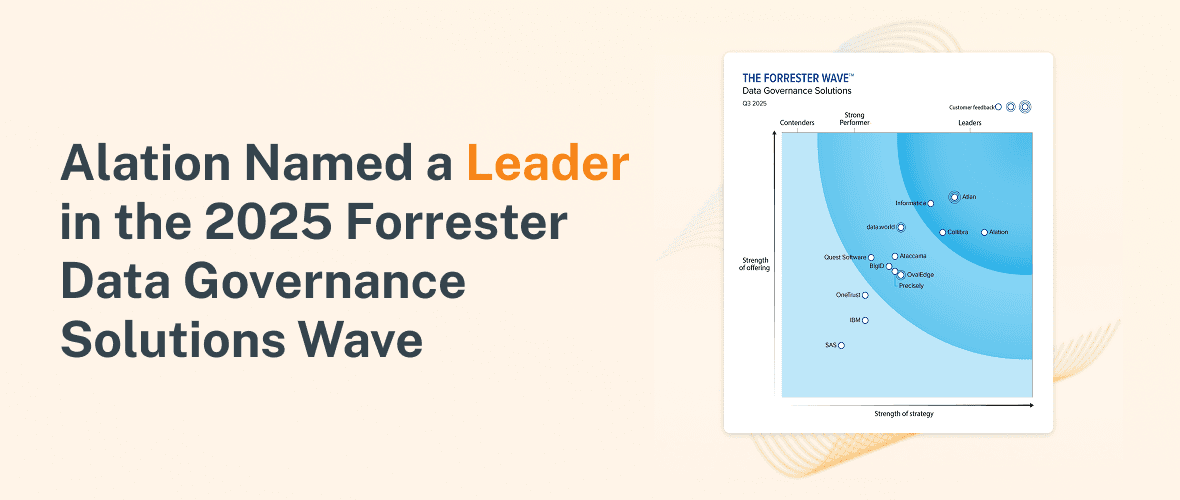
The structural advantage neither capability alone provides is what you get when they work together: governed data as the foundation of governed AI. Every model card can cite live data quality scores for its dependencies. Every approval workflow can evaluate whether the training data meets certification standards. Pure-play AI governance vendors govern the model but not the knowledge it consumes. Alation governs both. This is also the capability set Forrester recognized when it named Alation a Leader in The Forrester Wave: Data Governance Solutions, Q3 2025, citing the highest possible score in the strategy category. 7
Overcome AI governance obstacles with Alation
AI governance is the foundation of trustworthy AI—ethical, audit-ready, and financially successful. Companies that prioritize governance from the outset are better equipped to innovate confidently, meet regulatory requirements, and realize value from artificial intelligence across mission-critical use cases.
The cost of poor governance is no longer theoretical, as recent enforcement actions demonstrate. Yet the reward for doing it right is immense: faster innovation, stronger compliance posture, and greater stakeholder trust.
There's one more dimension worth naming. The organizations that will win with AI over time aren't just the ones that govern responsibly today; they're the ones that build governance systems that compound. When agent outputs get evaluated, and those evaluations feed back into improving the underlying business context, governance becomes a flywheel rather than a checkpoint. The data gets more trusted. The agents get more accurate. The cost of maintaining compliance goes down as the system learns.
That's the difference between AI governance as a cost center and AI governance as a competitive advantage. The former keeps you compliant. The latter makes your AI get better every time someone uses it.
Organizations aiming to harness generative AI face two key obstacles: a lack of expertise and the need to ensure accurate outputs. Watch this webinar, Building Trust in AI: Best Practices for AI Governance, from IDC's Stewart Bond, to learn how to prepare your AI initiatives for success.
Ready to lead in AI governance? Book a demo with Alation today.
FAQs
How does governed AI differ from AI governance in practice, not just in definition?
Governed AI and AI governance differ in what's being checked. AI governance tracks what's deployed, like model registries, compliance documentation, risk classifications. Governed AI tracks whether the knowledge those models and agents actually draw on (business definitions, data quality signals, semantic models) is accurate and consistent.
A model can pass every AI governance checkpoint and still produce confidently wrong answers if it's pulling from ungoverned or inconsistent semantic definitions.
If we already have governance built into our data platforms, why do we need a separate governance layer for AI?
You need a separate governance layer for AI because platform-native governance only sees what happens inside that platform. Most enterprises run AI across several platforms at once, and each one defines business metrics and semantic models independently.
When agents built on different platforms draw from different versions of the same concept they produce inconsistent outputs that erode trust in the whole AI program. A governance layer above any single platform keeps agents consistent regardless of which platform they run on.
Does complying with the EU AI Act or ISO 42001 automatically mean an organization's AI models are producing reliable outputs?
No. EU AI Act and ISO 42001 frameworks require documentation, risk classification, and audit trails; proof a system was built and monitored responsibly. None of these frameworks verify that the data and semantic definitions feeding the model are accurate.
An organization can satisfy every requirement on paper and still have agents drawing on stale or inconsistent business definitions, which produces outputs that are compliant but wrong. That’s why a solution like Alation AIOS is essential for reliable outputs.
Sources & notes
Every external claim on this page is independently verifiable.
The EU AI Act classifies AI systems by risk level, with documentation, transparency, and human-oversight requirements for high-risk use cases. — European Commission, AI Act Service Desk — https://ai-act-service-desk.ec.europa.eu/en/guideline-explorer
The NIST AI Risk Management Framework (AI RMF 1.0) organizes AI risk management into four functions: govern, map, measure, and manage. — National Institute of Standards and Technology — https://www.nist.gov/itl/ai-risk-management-framework
ISO/IEC 42001:2023 is the first international standard specifying requirements for an AI management system. — International Organization for Standardization — https://www.iso.org/standard/42001
Article 22 of the GDPR gives individuals the right not to be subject to a decision based solely on automated processing that produces legal or similarly significant effects. — EU General Data Protection Regulation, Article 22 — https://gdpr-info.eu/art-22-gdpr/
HHS's Office of the National Coordinator for Health IT (ONC) requires certified health IT to document specific “source attributes” — including training data composition, demographic representativeness, and validation results — for predictive decision support interventions used in clinical care, under the HTI-1 final rule. — HealthIT.gov, Decision Support Interventions (DSI) Fact Sheet, December 2023
Governance remains one of the persistent challenges organizations face in scaling self-service analytics adoption. — TDWI, “The State of Self-Service and Automation: Results from TDWI's Latest Research,” September 2025
Alation was named a Leader in The Forrester Wave™: Data Governance Solutions, Q3 2025, receiving the highest possible score in the strategy category. — The Forrester Wave™: Data Governance Solutions, Q3 2025, Forrester Research
Organizations that retrofit AI governance after deployment take substantially longer and spend significantly more than those that build governance in from the start — one case saw a 14-month timeline and nearly triple the budget compared to a peer that embedded governance upfront and reached production in six months. — CIO, “Your AI Rollout Is Succeeding. Your Organization Is Failing.” — https://www.cio.com/article/4193961/your-ai-rollout-is-succeeding-your-organization-is-failing.html
Organizations that build AI governance first, before scaling adoption, outperform their peers across every measured outcome. — Grant Thornton, 2026 AI Impact Survey Report — https://www.grantthornton.com/services/advisory-services/artificial-intelligence/2026-ai-impact-survey
- Active Data Governance
- Data Culture
- Data Intelligence
- Digital Transformation
- Engineering
- Enterprise Data Catalog
- AI
- Data Catalog
- Data Governance
- Data Quality
David Sweenor, founder of TinyTechGuides is an international speaker, and acclaimed author with several patents. He is a specialist in AI, ML, and data science.
Keep reading
More from the data desk